Nanocellulose:
AI server racks generate intense heat (20–50+ MW per facility). Rather than venting this thermal energy into the atmosphere, Waste2Nano captures it to power the production of Microcellulose (MC) and Nanocellulose (NC). Waste Mining.
AI data Centers:
We provide a “forever running” supply of treated effluent for cooling. This replaces the need for freshwater and provides a more consistent, mineral-light cooling source compared to groundwater, which often causes equipment scaling.
WWTP:
Our heat stream boosts efficiency in cold climates while cutting sludge volume by 50%. This reduction expands plant capacity and slashes costs by eliminating waste hauling and spreading. Lower expenses + less sludge = higher capacity + higher efficiency.
ABOUT US
We are a Michigan-based company with a central focus on the Midwest region that builds proprietary, custom-designed machinery engineered to scale. Our units are not “one-size-fits-all”; they are adapted to fit specific WWTP capacities and varying data center power densities. Our custom machines adapt to different waste streams. Whether a municipality processes 2 million or 20 million gallons per day, our equipment is modularized to integrate seamlessly into existing footprints.
Why Sewage + AI?
AI and sewage are permanent realities, yet we treat them as unrelated. Traditionally, sewage sludge is spread on land, but the EPA warns this cycles PFAS and microplastics into our food chain. Meanwhile, AI’s growth is staggering. In 2025, there are 99 mobile broadband subscriptions per 100 inhabitants, y, y, yet 2.1 billion people still lack safely managed drinking water. Cooling data centers with fresh water is no longer viable. At Waste2Nano, we bridge this gap with an integrated approach: Waste to High-Value Materials: We convert sewage solids—70% of which is typically land-applied—into cellulose and nanocellulose. We capture contaminantwith fresh water is no longer viable. At Waste2Nano, we bridge this gap with an integrated approach: Waste to High-Value Materials: We convert sewage solids—70% of which is typically land-applied—into cellulose and nanocellulose. We capture contaminants at the source, preventing them from entering The average American uses 82 gallons of water daily, most of which becomes wastewater. We repurpose this local resource for data center cooling, protecting the potable supply. the environment. Wastewater for AI Cooling: The average American uses 82 gallons of water daily, most of which becomes wastewater. We repurpose this local resource for data center cooling, protecting the potable supply. The average American uses 82 gallons per day, our equipment is modularized to integrate seamlessly into existing footprints.
A Great Lakes Crisis is Pending, Here’s How We Solve it.
The Great Lakes are at a breaking point. In early 2026, Lakes Michigan and Huron lost 3.2 trillion gallons of water in a single month—part of a decade-long decline that has dropped levels nearly 15 inches below normal.
As record-low water levels threaten our ecosystems, a new thirsty neighbor has arrived: AI Data Centers. A single hyperscale facility can consume up to 5 million gallons of fresh water daily—the same as a small city. Placing this demand on a stressed system is a losing strategy.
Waste2Nano offers the Waste Mining Revolution:
- Co-locate AI with Wastewater Plants: Instead of draining the Great Lakes, we use non-potable wastewater for data center cooling.
- Restore the Cycle: We extract high-value nanocellulose from waste solids onsite, preventing contaminated sludge (PFAS/microplastics) from being spread on farmland.
- Protect the 20%: The Great Lakes hold 20% of the world’s surface freshwater. We help the region lead in circular, water-resilient infrastructure.
Zero freshwater extraction. Zero greenwashing. Real solutions.
Introducing: The World’s First Nanocellulose Waste Miner Pilot.
- Small footprint (2-3 shipping containers), low electric consumption.
- Semi automated novel unit that converts organic waste into high-quality nanocellulose compositions. Robust, yet easily transportable& remote-controlled – working 24 / 7.
- Pilot scale – 0.5 MGD (Million Gallon per Day) (~5,000 people equivalent).
- Collect liquid (wastewater) and solid waste (textile and agriculture residues).
- Analyze the waste (the “nose” + hyperspectral + track DNA and other markers for human health).
- Separate and process the waste into cellulose and nanocellulose raw materials.
- Create resin for 3D printing and molding.

The Waste Mining Revolution Book
The Waste Mining Revolution by Dr. Refael Aharon presents a bold and practical rethinking of one of the world’s biggest challenges: waste. Rather than treating waste as an unavoidable burden, the book reframes it as a largely untapped resource capable of producing nanocellulose and other high-value materials with real industrial and environmental impact. Through real-world case studies and a clear systems-level approach, Dr. Aharon shows how existing waste streams can be transformed into the foundation of a scalable, circular economy.
For organizations operating in sustainability, materials science, or clean technology, this book offers more than theory. It provides the technical, economic, and strategic insight needed to design operations that are both environmentally responsible and financially viable. Supporting our operations with the knowledge in this book strengthens our ability to make informed decisions, optimize waste-to-value processes, and align innovation with long-term impact.
Beyond its operational relevance, the book delivers genuinely life-changing perspective. It challenges deeply rooted assumptions about pollution, scarcity, and value, fundamentally shifting how readers view waste in everyday life and at an industrial scale. By the end, waste is no longer something to manage or minimize, but a powerful opportunity for innovation, resilience, and economic growth. For innovators, policymakers, and forward-thinking leaders, this book does not just inform, it changes how you see the world you are building.
Meet Our Founder.
Dr. Refael Aharon is an inventor-operator and cleantech entrepreneur who specializes in taking hard problems out of the lab and into operating infrastructure. With over 20 years of experience building complex machinery and implementing waste-mining systems, he brings the full stack of know-how required to deliver deployable solutions: process design, mechanical integration, plant operations, and execution with real-world constraints (uptime, safety, permitting, and economics).
He is the author of The Waste Mining Revolution, which lays out a practical systems approach for turning global waste streams into high-value materials, especially cellulose and nanocellulose, through implementation-driven engineering rather than speculative R&D.
Prior to Waste2Nano, Dr. Aharon led and invented technologies that recover cellulose fibers and other valuable materials from wastewater and sludge, protected by issued patents including US 9,169,597 (Method of recycling fibers from sewage sludge) and
additional filings in wastewater-derived materials and nanocellulose processes.
Pioneering a new standard for how advanced societies manage wastewater and sewage. AI is here to stay and so is the heat it generates. Any truly advanced civilization will fully recover and recycle its resources, and AI should be
cooled with wastewater, not drinking water.
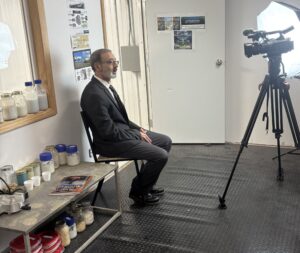
Refael Aharon
Chairman, CEO, CTO
Consulting, Training, & Implementation. Delivered End-to-End
Sustainable Cooling for AI & HPC
AI compute is scaling fast—fresh water is not. Waste2Nano helps operators transition to wastewater and reclaimed-water cooling to reduce environmental impact, improve site resilience, and accelerate deployment.
Our End-to-End Services
- Consulting & Feasibility: Site screening, cooling strategy selection, and ROI modeling.
- Training: Operator playbooks, maintenance protocols, and safety/compliance guidance.
- Implementation: Detailed engineering, vendor procurement, and commissioning support.
Who We Serve
We support Data Center Operators, HPC Facilities, and Municipalities looking to move from concept to deployment with water-resilient infrastructure.
- Contact us for a consultation: info@waste2nano.com
